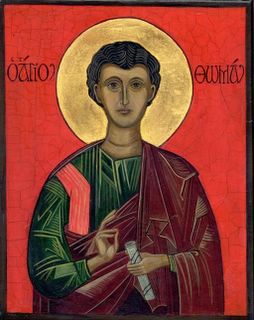
The intellect joined to God for long periods through prayer and love become wise, good, powerful, compassionate, merciful and long-suffering; in short it includes within itself almost all the divine qualities. But when the intellect withdraws from God and attaches itself to material things, either it becomes self-indulgent like some domestic animal, or like a wild beast it fights with men for the sake of these things. (Maximos the Confessor)
Until undertaking this "conversation" with Maximos I did not realize what a materialist I am.
I recognize the potential dichotomy between the material and spiritual. Most of those I know seem to be loyal citizens of the material world and suspicious or worse of the spiritual.
Maximos has recognized a symptom of profound spiritual deficiency, but I am not confident his is the only therapy.
I do not perceive God intends for us to reject the material or that such rejection is the only path to the spiritual.
Rather there is a need to heal that which has fractured the material and spiritual, reuniting and restoring what was meant to be joined.
Thursday, December 31, 2009

Wednesday, December 30, 2009

When you find your intellect occupied pleasurably with material things and becoming fondly attached to its conceptual images of them, you may be sure that you love these things more than God. For where your treasure is, there will your heart be also. (Maximos the Confessor)
Maximos is quoting from the sermon on the mount. A bit more context:
"Do not store up for yourselves treasures on earth, where moth and rust consume and where thieves break in and steal; but store up for yourselves treasures in heaven, where neither moth nor rust consumes and where thieves do not break in and steal. For where your treasure is, there your heart will be also." (Matthew 6:19-21)
It is a matter of priority and proportionality. I do not hear Jesus rejecting worldly pleasures (Maximos is more rigorous in this regard). But there is a clear injunction to put God and neighbor first.
God does not honor hoarding. When the gathering and keeping of stuff -- money, property, and more -- is motivated by conceptual images rooted in either fear or desire for control we are distracted from reality
God does not honor obsessions or compulsions. These are empty idols. God will help free us from unhelpful conceptual images and restore us to meaningful relationships.
God is calling us to fulfillment. We are fulfilled in relationship with what is real and present.
Tuesday, December 29, 2009
If a man does not love someone, it does not necessarily mean that he hates him; and conversely, if he does not hate him, it does not necessarily mean that he loves him, since he can be neutral towards him, that is, neither love him nor hate him. For the disposition to love is created only the five ways listed in the ninth text of the Century, one commendable, one of an intermediate kind, and three reprehensible. (Maximos the Confessor)
The nine ways previously identified are for the sake of God, by nature, by self-esteem, by avarice, and by self-indulgence.
I have defined love as recognizing an other as an expression of God. Maximos equates love as something closer to friendly affection and warm attraction.
Over the years I have sought to cultivate the ability to "love" those who may repulse me. The good and the beautiful do not always travel together.
Maximos challenges the comfortable distance allowed by my emotion-free definition of love. Love does not merely honor the other, love draws us to the other.
If I truly believe my most repulsive neighbor is an expression of God, I am called - quite reluctantly, I will admit - to open myself to him or her until the repulsion is replaced by some authentic aspect of appreciation.
The nine ways previously identified are for the sake of God, by nature, by self-esteem, by avarice, and by self-indulgence.
I have defined love as recognizing an other as an expression of God. Maximos equates love as something closer to friendly affection and warm attraction.
Over the years I have sought to cultivate the ability to "love" those who may repulse me. The good and the beautiful do not always travel together.
Maximos challenges the comfortable distance allowed by my emotion-free definition of love. Love does not merely honor the other, love draws us to the other.
If I truly believe my most repulsive neighbor is an expression of God, I am called - quite reluctantly, I will admit - to open myself to him or her until the repulsion is replaced by some authentic aspect of appreciation.
Monday, December 28, 2009
If a man is not envious or angry, and does not bear a grudge against someone who has offended him, that does not necessarily mean that he loves him. For, while still lacking love, he may be capable of not repaying evil with evil, in accordance with the commandment, and yet by no means be capable of rendering good for evil without forcing himself. To be spontaneously disposed to do good to those who hate you belongs to perfect spiritual love alone. (Maximos the Confessor)
To render good for evil as a matter of conscious will is not sufficient. Love is not only a discipline, it is a spontaneous expression.
This is not the spontaneity, however laudatory, that prompts a stranger to plunge into icy water to save a child. This love is self-sacrifice on behalf of those who have ignored, abused, and hated you. It is an expression of the same love with which Jesus forgave and transfigured those who crucified him.
I am a reasonable master of the stoic disciplines. I am not typically consumed by anger or envy. But I lack love and can be a clanging cymbal.
To render good for evil as a matter of conscious will is not sufficient. Love is not only a discipline, it is a spontaneous expression.
This is not the spontaneity, however laudatory, that prompts a stranger to plunge into icy water to save a child. This love is self-sacrifice on behalf of those who have ignored, abused, and hated you. It is an expression of the same love with which Jesus forgave and transfigured those who crucified him.
I am a reasonable master of the stoic disciplines. I am not typically consumed by anger or envy. But I lack love and can be a clanging cymbal.
Sunday, December 27, 2009

When a man's intellect is constantly with God, his desire grows beyond all measure into an intense longing for God and his incensiveness is completely transformed into divine love. For by continual participation in the divine radiance his intellect becomes totally filled with light; and when it has reintegrated its passible aspect, it redirects this aspect towards God, as we have said, filling it with an incomprehensible and intense longing for Him and with unceasing love, thus drawing it entirely away from worldly things to the divine. (Maximos the Confessor)
Through continual participation with one another our hearts are opened. Once opened, the concerns and capacities of our hearts can grow.
To participate is to be in relationship. The Latin root - participatus - means to share, to take part, and to partner. We are to participate with God. We are to participate with our neighbors.
Jesus urges us to be whole-hearted, to be fully engaged, to be completely committed. We are to be active partners with God and neighbor.
My failure to be whole-hearted is most often the result of fear or distraction. I restrain my present participation to reduce my vulnerability or because I am preoccupied with some abstraction.
Help me gracious God to continually participate in your divine radiance.
Saturday, December 26, 2009
Certain things stop the movement of the passions and do not allow them to grow; others subdue them and make them diminish. For instance, where desire is concerned, fasting, labour, and vigils do not allow it to grow, while withdrawal, contemplation, prayer, and intense longing for God subdue it and make it disappear. The same is true with regard to anger. Forbearance, freedom from rancour, gentleness, for example, all arrest it and prevent it from growing, while love, acts of charity, kindness and compassion make it diminish. (Maximos the Confessor)
What Maximos perceives as stopping the passions, I perceive as giving direction to the passions.
What is the source of our most intense desire? It is usually some sense of separation or need. But when we claim what we desire, it often does not satisfy and, indeed, seems to spur more intense desire.
Quite often we have projected our need for God as a need for something else. We have mistaken our separation from God as separation from some other.
God is so multi-faceted and expansive that we can engage God through a variety of sacraments. But for sacramental potential to be realized we must bring to it an awareness of the sacred.
While ultimately self-satisfying, the sacred almost always begins with self-sacrifice.
What Maximos perceives as stopping the passions, I perceive as giving direction to the passions.
What is the source of our most intense desire? It is usually some sense of separation or need. But when we claim what we desire, it often does not satisfy and, indeed, seems to spur more intense desire.
Quite often we have projected our need for God as a need for something else. We have mistaken our separation from God as separation from some other.
God is so multi-faceted and expansive that we can engage God through a variety of sacraments. But for sacramental potential to be realized we must bring to it an awareness of the sacred.
While ultimately self-satisfying, the sacred almost always begins with self-sacrifice.
Friday, December 25, 2009
The sensible man, taking into account the remedial effect of the divine prescriptions, gladly bears the sufferings which they bring upon him, since he is aware that they have no cause other than his own sin. But when the fool, ignorant of the supreme wisdom of God's providence, sins and is corrected, he regards either God or men as responsible for the hardships he suffers. (Maximos the Confessor)
I am my own worst enemy. In my desires, doubts and dithering are the origins of many hardships.
But difficulty also emerges from my effort - however faulty - to live in a manner consistent with God's intention.
Within God's soaring architecture human society has constructed a warren of low rooms and a veritable maze of tight passageways.
When trying to break out of these tacky additions, I have been disdained or worse. It is also true that, too often, where I thought tearing down an old wall would open into a great hall, it has, instead, merely opened into another part of the maze.
There are, I expect, boundaries to God's architecture. There are surely consequences to living inconsistently with the divine architecture.
But the distress I have experienced has not, so far, been the result of God's design or intervention, but the consequence of choices made by me and my neighbors.
The good news - celebrated with particular joy on this day - is that God walks and works with us in clearing away the slums and tenements to restore and build-anew a beautiful city.
I am my own worst enemy. In my desires, doubts and dithering are the origins of many hardships.
But difficulty also emerges from my effort - however faulty - to live in a manner consistent with God's intention.
Within God's soaring architecture human society has constructed a warren of low rooms and a veritable maze of tight passageways.
When trying to break out of these tacky additions, I have been disdained or worse. It is also true that, too often, where I thought tearing down an old wall would open into a great hall, it has, instead, merely opened into another part of the maze.
There are, I expect, boundaries to God's architecture. There are surely consequences to living inconsistently with the divine architecture.
But the distress I have experienced has not, so far, been the result of God's design or intervention, but the consequence of choices made by me and my neighbors.
The good news - celebrated with particular joy on this day - is that God walks and works with us in clearing away the slums and tenements to restore and build-anew a beautiful city.
Thursday, December 24, 2009

Trials are sent to some so as to take away past sins, to others so as to eradicate sins now being committed, and to yet others so as to forestall sins which may be committed in the future. These are distinct from the trials that arise in order to test me in the way that Job was tested. (Maximos the Confessor).
If Maximos had chosen a passive verb - perhaps "trials can serve so as to take away..." - I would have very little to say.
The middle English source of trial means to sort, to sift, or to separate. The choices we make to resolve (or not) our struggles are fundamental to the discovery and crafting of self. The relationships forged in the midst of struggle are often the strongest and deepest of all. In our individual lives, in our families, communities, and beyond we encounter gaps between what is and what might be. We can endeavor to narrow the gap, bridge it, or fill it. Or we can widen the gap into a chasm.
God's architecture does engage the tension between objects, between options, and between free creatures. But God does not send trials and tests. God has demonstrated, again and again, how the architecture is optimized through mindful and mutually supportive relationship. The architect's clear intention is for us to make choices whereby each of us, all of us, and the architecture is able to thrive. Fortunately the architecture is sufficiently resilient to survive neglect and abuse.
Wednesday, December 23, 2009
As long as you have bad habits do not reject hardship, so that through it you may be humbled and eject your pride. Sometimes men are tested by pleasure, sometime by distress or by physical suffering. But means of His prescriptions the Physician of souls administers the remedy according to the cause of the passions lying hidden in the soul. (Maximos the Confessor)
Tough times can be very good for character-building, cultivating wisdom, and soul-making. God is ready to help with all this and more.
Surely pleasure can test and try us as much as distress. Every encounter with another - good or ill - is an opportunity to make and find meaning.
God is a great physician. I have found God's remedies remarkable. I depend on God's concern and care.
With God's help I can discern and give direction to the passions lying hidden in my soul. In every case I have found these passions to be God's gift.
We are not called is dispassion but passion for God's purposes, wherein we will find our soul's fulfillment.
Tough times can be very good for character-building, cultivating wisdom, and soul-making. God is ready to help with all this and more.
Surely pleasure can test and try us as much as distress. Every encounter with another - good or ill - is an opportunity to make and find meaning.
God is a great physician. I have found God's remedies remarkable. I depend on God's concern and care.
With God's help I can discern and give direction to the passions lying hidden in my soul. In every case I have found these passions to be God's gift.
We are not called is dispassion but passion for God's purposes, wherein we will find our soul's fulfillment.
Tuesday, December 22, 2009
When a trial comes upon you unexpectedly, do not blame the person through whom it came but try to discover the reason why it came, and then you will find a way of dealing with it. For whether through this person or through someone else you had in any case to trink the wormwood of God's judgments. (Maximos the Confessor).
I agree with the first sentence. I fundamentally disagree with the second.
If we regularly behave in a manner inconsistent with God's architecture there will be consequences. Floors will crack. The roof might even fall in.
There can be benefit in reflection and self-criticism, whatever the context. But if every time we lose a job, suffer a disease, or are caught up in tragedy we perceive the hand of God, we unnecessarily complicate our relationship with God.
In the life, death, and resurrection of Jesus we can learn much. Certainly we can see that evil is done even to the innocent. We can also see that evil does not have the final say.
God is with us. Whether the source of suffering is evil or error or accident, God is with us.
I agree with the first sentence. I fundamentally disagree with the second.
If we regularly behave in a manner inconsistent with God's architecture there will be consequences. Floors will crack. The roof might even fall in.
There can be benefit in reflection and self-criticism, whatever the context. But if every time we lose a job, suffer a disease, or are caught up in tragedy we perceive the hand of God, we unnecessarily complicate our relationship with God.
In the life, death, and resurrection of Jesus we can learn much. Certainly we can see that evil is done even to the innocent. We can also see that evil does not have the final say.
God is with us. Whether the source of suffering is evil or error or accident, God is with us.
Monday, December 21, 2009

Almost every sin is committed for the sake of sensual pleasure; and sensual pleasure is overcome by hardship and distress arising either voluntarily from repentance, or else involuntarily as a result of some salutary and providential reversal. "For if we would judge ourselves, we should not be judged; but when we are judged, we are chastened for the Lord, so that we should not be condemned with the world." (Maximos the Confessor)
In my own experience and in observation of others, most sensual sins pale in contrast to the sins of pride and fear. And too often, confronting the sensual sins inflame pride or fear.
Is sensual pleasure overcome or redirected? What is more sensual than the Eucharist? Or Chartres? Or almost anything by Bach? Or any mindful walk in nature? Jesus welcomed the woman with the alabaster jar and her care.
Certainly, let us judge ourselves. But let us judge rightly. We were not given the senses to tempt us, but to assist us in knowing God.
Sunday, December 20, 2009
We grow proud when the passions cease to be active in us, and this whether they are inactive because their causes have been eradicated or because the demons have deliberately withdrawn in order to deceive us. (Maximos the Confessor)
I am bi-polar. The symptoms and consequences have been active since my early teens. There were especially difficult and extended episodes of depression in my twenties.
For most of the last thirty years with counseling, diet, exercise, self-awareness and self-discipline, my experience of depression has been comparatively benign.
The cause has not, however, been eradicated. The symptoms still flare. But given my experience, I can usually perceive an on-set sufficiently early to mitigate the impact.
This ailment has bred attention, cultivated moderation, and encouraged empathy. I give God thanks for it as a great gift, an angelic protector, a tool for mindful living.
I am fully aware the cause is beyond my power to eradicate and the demons are always trying to deceive us.
I am bi-polar. The symptoms and consequences have been active since my early teens. There were especially difficult and extended episodes of depression in my twenties.
For most of the last thirty years with counseling, diet, exercise, self-awareness and self-discipline, my experience of depression has been comparatively benign.
The cause has not, however, been eradicated. The symptoms still flare. But given my experience, I can usually perceive an on-set sufficiently early to mitigate the impact.
This ailment has bred attention, cultivated moderation, and encouraged empathy. I give God thanks for it as a great gift, an angelic protector, a tool for mindful living.
I am fully aware the cause is beyond my power to eradicate and the demons are always trying to deceive us.
Saturday, December 19, 2009
The person who has come to know the weakness of human nature has gained experience of divine power. Such a man, having achieved some things and eager to achieve others through this divine power, never belittles anyone. For he know that just as God has helped him and freed him from many passions and difficulties, so, when God wishes, He is able to help all men, especially those pursuing the spiritual way for His sake. And if in His providence He does not deliver all men together from their passions, yet like a good and loving physician He heals with individual treatment each of those who are trying to make progress. (Maximos the Confessor)
Each of us is an expression of God. Each of us is worthy of honor.
Even at our worst, even when trapped in error, banality, and depravity, we do not forsake our essential nature.
I am less certain than Maximos seems to be regarding the alchemy of grace. I am not sure if it requires God's active intervention or our active acceptance or some other action, interaction, reaction, or ceasing of action.
I have found grace most present when I have stopped trying to make progress and have, instead, been attentive to my current place and condition.
Our creator God certainly honors our desire to create, to grow, and to change. But God's grace is present in regression as well as progress, in loss as well as gain.
Each of us is an expression of God. Each of us is worthy of honor.
Even at our worst, even when trapped in error, banality, and depravity, we do not forsake our essential nature.
I am less certain than Maximos seems to be regarding the alchemy of grace. I am not sure if it requires God's active intervention or our active acceptance or some other action, interaction, reaction, or ceasing of action.
I have found grace most present when I have stopped trying to make progress and have, instead, been attentive to my current place and condition.
Our creator God certainly honors our desire to create, to grow, and to change. But God's grace is present in regression as well as progress, in loss as well as gain.
Friday, December 18, 2009

The malice of the demon of pride takes two forms. Either he persuades the monk to ascribe his achievements to himself and not to God, the Giver of all goodness and helper in every achievement; or, if this fails, he suggests that he should belittle those of his brethern who are as yet less perfect than himself. Influenced in this way, he does not realize that the demon is persuading him to deny God's help. For if he belittles his brethern for their lack of achievement, he clearly infers that he has achieved something through his own powers. But this is impossible, since, as our Lord has said, "Without Me you can do nothing." For even when impelled towards what is good, our weakness cannot bring anything to fruition with the Giver of all goodness. (Maximos the Confessor)
This insight is applicable far beyond the monastery. There is nothing we can do to earn spiritual achievement. We accept grace and live in accordance with grace or we do not.
I wonder how Maximos squares this insight with his prior instructions on self-organized spiritual discipline.
In my critique of Maximos, I am not advocating license. But meaningful spiritual achievement is the result of being in loving relationship with God and neighbor.
If and when I focus on my sinful separation from God and what I must do to climb closer; or in differentiating myself from those who I perceive are sinning, I seek to separate from them, I have been tricked by the demon of pride.
I am a sinner. I will be a sinner. But I can accept God's grace and I can live in loving relationship with God and my neighbor.
Thursday, December 17, 2009
In everything that we do God searches out our purpose to see whether we do it from Him or for some other motive. When you hear the words of Scripture, "Thou shalt render to every man according to his work," do not think that God bestows blessings when something is done for the wrong purpose, even though it seems to be good. Quite clearly He bestows blessings only when something is done for right purpose. For God's judgment looks not at the actions but at the purpose behind them. (Maximos the Confessor)
In creating the universe I perceive God applies an architecture. When we make choices consistent with that architecture the outcomes are more likely to be as anticipated.
Quite clearly this architecture includes considerable randomness. Outcomes can be unpredictable, even when we attempt to calibrate our choices to the architecture.
But in shaping our intention to God's intention, matching our purpose to God's purpose, and working to extend the weave that God has begun we are more likely to achieve fulfillment.
In creating the universe I perceive God applies an architecture. When we make choices consistent with that architecture the outcomes are more likely to be as anticipated.
Quite clearly this architecture includes considerable randomness. Outcomes can be unpredictable, even when we attempt to calibrate our choices to the architecture.
But in shaping our intention to God's intention, matching our purpose to God's purpose, and working to extend the weave that God has begun we are more likely to achieve fulfillment.
Wednesday, December 16, 2009
Many human activities, good in themselves, are not good because of the motive for which they are done. For example, fasting and vigils, prayer and psalmody, acts of charity and hospitality are by nature good, but when performed for the sake of self-esteem they are not good. (Maximos the Confessor)
When I began daily meditations on the web I hoped to attract others. This motivation was partly a matter of serving others, partly the hope for dialogue, but had some significant element of what Maximos would call self-esteem.
I love singing in Church. I don't want to "perform" in the choir and I don't like being noticed for my singing. Singing has become just about as close as I get to pure praise and worship of God.
My approach to hospitality is usually overdone. There is too much projection of self, rather than serving the guest. I used to be better at it, but we are so seldom visited that hospitality requires -- or I think it requires -- self-conscious effort.
Acts of worship and acts of service -- the principal means of being in relationship with God and neighbor -- are opportunities to step outside the self, to lose the burden of self, and discover the joy of being in relationship with an other.
Since September 17, 2005 I have authored a morning meditation. In that first blog post I wrote, "We are called to praise not for the sake of God, but for our own sake. Too often we are preoccupied by worry regarding the future. Too often we are in mourning for that which is past. Too seldom do we recognize the blessing of the here and now."
I am glad only one or two others read these writings. In the silence my self is focused only on my relationship with the text and, on the best days, through the text to my relationship with God and neighbor.
When I began daily meditations on the web I hoped to attract others. This motivation was partly a matter of serving others, partly the hope for dialogue, but had some significant element of what Maximos would call self-esteem.
I love singing in Church. I don't want to "perform" in the choir and I don't like being noticed for my singing. Singing has become just about as close as I get to pure praise and worship of God.
My approach to hospitality is usually overdone. There is too much projection of self, rather than serving the guest. I used to be better at it, but we are so seldom visited that hospitality requires -- or I think it requires -- self-conscious effort.
Acts of worship and acts of service -- the principal means of being in relationship with God and neighbor -- are opportunities to step outside the self, to lose the burden of self, and discover the joy of being in relationship with an other.
Since September 17, 2005 I have authored a morning meditation. In that first blog post I wrote, "We are called to praise not for the sake of God, but for our own sake. Too often we are preoccupied by worry regarding the future. Too often we are in mourning for that which is past. Too seldom do we recognize the blessing of the here and now."
I am glad only one or two others read these writings. In the silence my self is focused only on my relationship with the text and, on the best days, through the text to my relationship with God and neighbor.
Tuesday, December 15, 2009

The rewards for the toils of virtue are dispassion and spiritual knowledge. For these are mediators of the kingdom of heaven, just as passions and ignorance are mediators of eternal punishment. It is because of this that he who seeks these rewards for the sake of human glory and not for their intrinsic goodness is rebuked by the words of Scripture, "You ask, and do not receive, because you ask wrongly." (Maximos the Confessor)
Maximos and James seem intent on explaining the Gospel of Luke, where Jesus is quoted as saying,
"So I say to you: Ask and it will be given to you; seek and you will find; knock and the door will be opened to you. For everyone who asks receives; he who seeks finds; and to him who knocks, the door will be opened." (Luke 11, 9-10)
When we do not win the lottery, when we lose our job, when the cancer wins, or when our child is killed in war, how do we explain the failure of prayer? Have we, somehow, asked wrongly?
I wonder if the problem is not in how we ask, but in our expectations of what we will receive. In the next two verses, Jesus continues,
"Which of you fathers, if your son asks for a fish, will give him a snake instead? Or if he asks for an egg, will give him a scorpion? If you then, though you are evil, know how to give good gifts to your children, how much more will your Father in heaven give the Holy Spirit to those who ask him!"
In response we will receive the Holy Spirit. Do we recognize how this gift is responsive to our prayers?
Monday, December 14, 2009
There are also three things that impel us towards evil: passions, demons and sinfulness of intention. Passions impel us when, for example, we desire something beyond what is reasonable, such as food which is unnecessary or untimely, or a woman who is not our wife or for a purpose other than procreation, or else when we are excessively angered or irritated by, for instance, someone who has dishonored or injured us. Demons impel us when, for example, they catch us off our guard and suddenly launch a violent attack upon us, stirring up the passions already mentioned and others of a similar nature. We are impelled by sinfulness of intention when, know the good, we choose evil instead. (Maximos the Confessor)
I understand evil to be, at least in part, a self-interested manipulation of reality to purposefully mislead another.
The three things that are most likely to impel me towards evil are misperception of reality, lack of honest self-awareness, and the absence of authentic concern for an other.
God is the ultimate reality. I am to love God and neighbor as myself. Nurturing the trinity of God-neighbor-self is a strong counter to evil.
I understand evil to be, at least in part, a self-interested manipulation of reality to purposefully mislead another.
The three things that are most likely to impel me towards evil are misperception of reality, lack of honest self-awareness, and the absence of authentic concern for an other.
God is the ultimate reality. I am to love God and neighbor as myself. Nurturing the trinity of God-neighbor-self is a strong counter to evil.
Sunday, December 13, 2009
There are three things that impel us toward what is holy: natural instincts, angelic powers and probity of intention. Natural instincts impel us when, for example, we do to others what we wish them to do to us, or when we see someone suffering deprivation or in need and naturally feel compassion. Angelic powers impel us when, being ourselves impelled to something worthwhile, we find we are providentially helped and guided. We are impelled by probity of intention when discriminating between good and evil, we choose good. (Maximos the Confessor)
I am impelled, but do I go?
Do I combine my compassion with action? Only on occasion.
Do I give thanks for providential help and guidance? Sometimes.
Do I choose good and reject evil? Yes, but too often I may not even recognize the difference.
If I more often act with compassion and give thanks to God, such experiences will almost certainly teach me greater discrimination.
I am impelled, but do I go?
Do I combine my compassion with action? Only on occasion.
Do I give thanks for providential help and guidance? Sometimes.
Do I choose good and reject evil? Yes, but too often I may not even recognize the difference.
If I more often act with compassion and give thanks to God, such experiences will almost certainly teach me greater discrimination.
Saturday, December 12, 2009

The passions lying hidden in the soul provide the demons with the means of arousing impassioned thoughts in us. Then, fighting the intellect through these thoughts, they force it to its assent to sin. When it has been overcome, they lead it to sin in the mind; and when this has been done they induce it, captive as it is, to commit the sin in action. Having thus desolated the soul by means of these thoughts, the demons then retreat, taking the thoughts with them, and only the spectre or idol of sin remains in the intellect. Referring to this our Lord says, "When you see the abominable idol of desoloation standing in the holy place (let him who reads understand) ..." For man's intellect is a holy place and a temple of God in which the demons, having desolated the soul by means of impassioned thoughts, set up the idol of sin. That these things have already taken place in history no one, I think, who has read Josephus will doubt; though some say that they will also come to pass in the time of the Antichrist. (Maximos the Confessor)
In The Screwtape Letters and other writings, C.S. Lewis describes how we can be incrementally undone. A modest pride, just a bit of fear, only a touch of avarice is a sufficient start.
Thought is powerful. Words are powerful. The distance between conceiving and doing need not be far, regardless of the conception or consequence, good or bad. Demons exploit the possibilities.
Maximos prescribes a life where the ascetic's inner world is focused tightly on the direct experience of God. For some, such discipline and purpose is surely a good prescription. I am not - yet - convinced it is right for me.
In the ninth letter of Screwtape to his nephew it is explained, "The attack has a much better chance of success when the man's whole inner world is drab and cold and empty."
In my own life the demons seem to be dissuaded by beauty. This morning's rising crescent moon, a Bach cantata, a wonderful meal, a sparkling dialogue, a shared effort to create...
These sensualities are, at least it seems to me, how I move closer to God. Maximos seeks an inner world filled with the transendent light of God-in-God. I find something very close to transcendence when my inner world is filled with the natural light that God has made and the man-made illumination that God empowers.
Friday, December 11, 2009
For him who is perfect in love and has reached the summit of dispassion there is no difference between his own or another's, or between Christians and unbelievers, or between slave and free, or even between male and female. But because he has risen above the tyranny of the passions and has fixed his attention on the single nature of man, he looks on all in the same way and shows the same disposition to all. For in him there is neither Greek nor Jew, male nor female, bond nor free, but Christ who "is all, and in all." (Maximos the Confessor)
I have sometimes found Maximos to be too much a Greek and not sufficiently a Jew. I am sure he would find me to be entirely too tied to sensuality and passion.
The conversation has nonetheless been worthwhile. Maximos has aggravated and challenged me. His otherness has encouraged me to greater clarity regarding what I perceive and why.
We have also found common ground. The words above were written nearly 1500 years ago. To many, even to many Christians, they are still startling. These words capture the core of my personal creed.
The differences between Maximos and I, between most of us, can be very helpful. The differences remind us of the breadth and depth of God, far beyond our comprehension.
Honoring the freedom and creativity God has bequeathed to each and all, motivated by love for God and neighbor, the clash of difference can be a beautiful song.
I have sometimes found Maximos to be too much a Greek and not sufficiently a Jew. I am sure he would find me to be entirely too tied to sensuality and passion.
The conversation has nonetheless been worthwhile. Maximos has aggravated and challenged me. His otherness has encouraged me to greater clarity regarding what I perceive and why.
We have also found common ground. The words above were written nearly 1500 years ago. To many, even to many Christians, they are still startling. These words capture the core of my personal creed.
The differences between Maximos and I, between most of us, can be very helpful. The differences remind us of the breadth and depth of God, far beyond our comprehension.
Honoring the freedom and creativity God has bequeathed to each and all, motivated by love for God and neighbor, the clash of difference can be a beautiful song.
Thursday, December 10, 2009
He who combines the practice of the virtues with spiritual knowledge is a man of power. For with the first he withers his desire and tames his incensiveness, and with the second he gives wings to his intellect and goes out of himself to God. (Maximos the Confessor)
I needed to check the definitions of wither and incensive. Maximos means to prune our desire and tame our tendency for excitement or being inflamed.
Another definition - enthusiasm - derived from LL enthūsiasmus and Greek enthousiasmós, equiv. to enthousí(a) possession by a god (énthous, var. of éntheos having a god within, equiv. to en- en- 2 + -thous, -theos god-possessing + -ia y3 ) + -asmos, var., after vowel stems, of -ismos -ism
The best pruning and taming increases our awareness of entheos, God within.
I needed to check the definitions of wither and incensive. Maximos means to prune our desire and tame our tendency for excitement or being inflamed.
Another definition - enthusiasm - derived from LL enthūsiasmus and Greek enthousiasmós, equiv. to enthousí(a) possession by a god (énthous, var. of éntheos having a god within, equiv. to en- en- 2 + -thous, -theos god-possessing + -ia y3 ) + -asmos, var., after vowel stems, of -ismos -ism
The best pruning and taming increases our awareness of entheos, God within.
Wednesday, December 9, 2009

If you are about to enter the realm of theology, do not seek to descry God's inmost nature, for neither the human intellect nor that of any other being under God can experience this; but try to discern as far as possible the qualities that appertain to His nature - qualities of eternity, infinity, indeterminateness, goodness, wisdom, and the power of creating, preserving and judging creatures, and so on. For he who discovers these qualities, to however small an extent, is a great theologian. (Maximos the Confessor)
That God is creative and free, seems to me beyond doubt. God also grants each of these qualities to you, me, and all of creation. In this way we are partners with God.
How we create and what we do with our freedom either extends or diminishes God's intention. A theologian - or any of us - ought give close attention to divine intention.
Is beauty an intention or a by-product? Is the interplay of order and randomness intentional or just a secondary feature of the system? Is love an input or an output?
The answers may be beyond human certainty. But such questions - and the struggle to answer - can focus our attention and shape our own intention.
What will you create today? How will you invest your freedom? How do your choices reflect your relationship with God and neighbor?
Tuesday, December 8, 2009
When the intellect practices the virtues correctly, it advances in moral understanding. When it practices contemplation it advances in spiritual knowledge. The first leads the spiritual contestant to discriminate between virtue and vice; the second leads the participant to the inner qualities of incorporeal and corporeal things. Finally, the intellect is granted the grace of theology when, carried on wings of love beyond these two former stages, it is taken up into God and with the help of the Holy Spirit discerns - as far as this is possible for the human intellect - the qualities of God. (Maximos the Confessor)
When we are in virtuous relationship with others, when we engage others as expressions of God, we advance in moral understanding. When we listen regularly to God we advance in spiritual knowledge.
For some the abstraction Maximos describes is the ecstatic outcome. For others this daily discipline will motivate increasing service to others and God.
I am not sure if either is better than the other. The most grounded may experience the ecstatic. Very abstract theologians have empowered and exemplified courage and care. God invites us to find our way from wherever we must begin.
When we are in virtuous relationship with others, when we engage others as expressions of God, we advance in moral understanding. When we listen regularly to God we advance in spiritual knowledge.
For some the abstraction Maximos describes is the ecstatic outcome. For others this daily discipline will motivate increasing service to others and God.
I am not sure if either is better than the other. The most grounded may experience the ecstatic. Very abstract theologians have empowered and exemplified courage and care. God invites us to find our way from wherever we must begin.
Monday, December 7, 2009
The reward of self-control is dispassion, and the reward of faith is spiritual knowledge. Dispassion engenders discrimination, and spiritual knowledge engenders love for God. (Maximos the Confessor)
Those who know me best would probably agree (complain?) that I have considerable self-control. This has not always resulted in dispassion. By itself, self-control can inflame the passions as much as quiet them.
Maximos is almost certainly advocating apatheia (ἀπάθεια). For the Stoics, writing five centuries before Maximos, apatheia is freedom from emotional disturbance. It is a rational and ego-free reaction to external events.
Five centuries after Maximos, the great theologian of the Eastern Church Symeon wrote,
I affirm that dispassion (apatheia) consists not only in abstaining from the prompting of the passions, but in abandoning all desire for them, and even more, in divesting our mind from their fantasies. Thus, if we so desire, we rise above the heavans, beyond all the visible and sensory, as if our senses were closed and our mind hand entered the super-sensible world, lifting the senses forcibly with it, like an eagle lifts its wings.
But the most finely tuned apatheia is insufficient and can be misleading. On my own, even at my most rational and courageous - perhaps especially then - I will choose poorly. Dispassion must be wedded to love of God and neighbor.
Maximos tells us that spiritual knowledge is the reward of faith. Is it also the essential substance of faith?
Those who know me best would probably agree (complain?) that I have considerable self-control. This has not always resulted in dispassion. By itself, self-control can inflame the passions as much as quiet them.
Maximos is almost certainly advocating apatheia (ἀπάθεια). For the Stoics, writing five centuries before Maximos, apatheia is freedom from emotional disturbance. It is a rational and ego-free reaction to external events.
Five centuries after Maximos, the great theologian of the Eastern Church Symeon wrote,
I affirm that dispassion (apatheia) consists not only in abstaining from the prompting of the passions, but in abandoning all desire for them, and even more, in divesting our mind from their fantasies. Thus, if we so desire, we rise above the heavans, beyond all the visible and sensory, as if our senses were closed and our mind hand entered the super-sensible world, lifting the senses forcibly with it, like an eagle lifts its wings.
But the most finely tuned apatheia is insufficient and can be misleading. On my own, even at my most rational and courageous - perhaps especially then - I will choose poorly. Dispassion must be wedded to love of God and neighbor.
Maximos tells us that spiritual knowledge is the reward of faith. Is it also the essential substance of faith?
Sunday, December 6, 2009

All the discourses of our Lord contain these four elements: commandments, doctrines, threats and promises. With the help of these we patiently accept every kind of hardship, such as fasting, vigils, sleeping on the ground, toil and labour in acts of service, insults, dishonour, torture, death, and so on. "Helped by the words of thy lips," says the psalmist, "I have kept to difficult paths." (Maximos the Confessor)
The interstates are easy and, usually, quick. They are also crowded and boring. It is more meaningful to find paths less taken.
Where am I going? How should I get there? Joseph Campbell noticed that in the quest for the holy grail, each of the archetypal heroes must find their own entrance into the enchanted forest, their own beginning, their own path.
Campbell was famous for perceiving similar stages in the journey of most heroes. But our particular path will be, needs to be, unique.
Saturday, December 5, 2009
Some men abstain from the passions because of human fear, others because of self-esteem, and others through self-control. Some, however, are delivered from the passions by divine providence. (Maximos the Confessor)
If Maximos had begun his second sentence with "All" rather than "Some" I might simply agree.
The most likely Greek verb for abstain is some form of apecho. This is an innately paradoxical term. Depending on context it can mean either to hold back or to have in full.
We can and should abstain from those feelings, motivations, and intentions than separate us from God and neighbor. But if we try to depend on our own strength and will, such resistance will only inflame the epipothe'sis.
All are delivered from the passions by the divine providence. Only by giving ourselves wholly to God and neighbor are we freed.
It is certainly an issue of apecho, but the context calls for giving rather than resisting.
If Maximos had begun his second sentence with "All" rather than "Some" I might simply agree.
The most likely Greek verb for abstain is some form of apecho. This is an innately paradoxical term. Depending on context it can mean either to hold back or to have in full.
We can and should abstain from those feelings, motivations, and intentions than separate us from God and neighbor. But if we try to depend on our own strength and will, such resistance will only inflame the epipothe'sis.
All are delivered from the passions by the divine providence. Only by giving ourselves wholly to God and neighbor are we freed.
It is certainly an issue of apecho, but the context calls for giving rather than resisting.
Friday, December 4, 2009
The demons are weakened when the passions in us decrease through our keeping the commandments; and they are defeated totally when they are routed by dispassion, for then they no longer find anything through which they can enter the soul and fight against it. This is what is meant by "they will be weakened and defeated before thy face." (Maximos the Confessor)
Maximos is almost certainly quoting from the third verse of the ninth psalm. Here is a contemporary translation:
I will give thanks to the Lord with my whole heart;
I will recount all of your wonderful deeds.
I will be glad and exult in you;
I will sing praise to your name, O Most High.
When my enemies turn back,
they stumble and perish before your presence.
For you have maintained my just cause;
you have sat on the throne, giving righteous judgment.
You have rebuked the nations; you have made the wicked perish;
It is God who maintains, God who gives judgment. It is our role to give thanks, recount, be glad, and sing praise.
Maximos is almost certainly quoting from the third verse of the ninth psalm. Here is a contemporary translation:
I will give thanks to the Lord with my whole heart;
I will recount all of your wonderful deeds.
I will be glad and exult in you;
I will sing praise to your name, O Most High.
When my enemies turn back,
they stumble and perish before your presence.
For you have maintained my just cause;
you have sat on the throne, giving righteous judgment.
You have rebuked the nations; you have made the wicked perish;
It is God who maintains, God who gives judgment. It is our role to give thanks, recount, be glad, and sing praise.
Thursday, December 3, 2009

He who anoints his intellect for spiritual contest and drives all impassioned thoughts out of it has the quality of a deacon. He who illuminates his intellect with the knowledge of created being and utterly destroys false knowledge has the quality of a priest. And he who perfects his intellect with the holy myrrh of the knowledge and worship of the Holy Trinity has the quality of a bishop. (Maximos the Confessor)
Who anoints? Who illuminates? Who perfects?
We have an essential role, but we are not alone. On our own we would struggle to qualify for sexton.
The garden of our soul benefits from cutting back epipothe'sis. It can be fertlized and watered. The blossoms of the soul are more likely to flourish under the care of a knowledgable gardener.
But the gardener depends on God for soil and rain and sun and much more.
We are not - ought not be - engaged in lonely self-perfecting.
Wednesday, December 2, 2009
Those who are always trying to lay hold of our soul do so by means of impassioned thoughts, so that they may drive it to sin either in the mind or in action. Consequently, when they find the intellect unreceptive, they will be disgraced and put to shame; and when they find the intellect occupied with spiritual contemplation, they will be turned back and suddenly ashamed. (Maximos the Confessor)
I am not called to the monastic life. I do not perceive this is God's purpose for me. Maximos is not writing for me.
But impassioned thoughts - epipothe'sis - are relevant. Plato suggests we are motivated by goodness, truth, and beauty. We might capitalize each. He argues that we will not be be satisfied until we experience the ideal of each.
Such ideals are not, typically, immediately accessible. We encounter shadows of each. We may even - usually do - confuse a shadow for its ultimate form.
Plato - perhaps in tension with Maximos - perceives that by fully engaging a shadow, coming to know its limits, we can eventually move closer to its source.
I understand Jesus to say that in fully engaging our neighbors and our selves, shadows of God, we can eventually move closer to God.
I am not called to the monastic life. I do not perceive this is God's purpose for me. Maximos is not writing for me.
But impassioned thoughts - epipothe'sis - are relevant. Plato suggests we are motivated by goodness, truth, and beauty. We might capitalize each. He argues that we will not be be satisfied until we experience the ideal of each.
Such ideals are not, typically, immediately accessible. We encounter shadows of each. We may even - usually do - confuse a shadow for its ultimate form.
Plato - perhaps in tension with Maximos - perceives that by fully engaging a shadow, coming to know its limits, we can eventually move closer to its source.
I understand Jesus to say that in fully engaging our neighbors and our selves, shadows of God, we can eventually move closer to God.
Tuesday, December 1, 2009
The demon of unchastity is powerful and violently attacks those who struggle against passion, particulary if they are lax about matters of diet and often meet women. With the lubricity of sensual pleasure he imperceptively steals into the intellect and thereafter persecutes the hesychast by means of memory, setting his body on fire and presenting various forms to the intellect. In this way he evokes his assent to sin. If you do not want these forms to linger in you, turn again to fasting, labour, vigils and blessed stillness with intense prayer. (Maximos the Confessor)
A vow of chastity has been undertaken. The purpose of the hesychast (Greek hesychos = quiet) in undertaking the vow is more ambitious than most. Through ascetic detachment from the world, profound prayer, and a perfect repose of mind and body he seeks to see the uncreated light of God.
Temptation arises from memory, abstract conceptualization, sensuality, and opportunity. It has, apparently, almost nothing to do with the woman presently at hand. The encounter with the other is sufficiently fraught and so brief, that it is almost certainly nothing more than an expression of lust.
I am tempted by the example of the hesychast. This tradition explicitly seeks the light of the Transfiguration. Yet following his Transfiguration, while Peter sought to preserve the mystic moment, Jesus left the mountain to heal, teach, and fulfill his purpose in relationship with God and his neighbors.
A vow of chastity has been undertaken. The purpose of the hesychast (Greek hesychos = quiet) in undertaking the vow is more ambitious than most. Through ascetic detachment from the world, profound prayer, and a perfect repose of mind and body he seeks to see the uncreated light of God.
Temptation arises from memory, abstract conceptualization, sensuality, and opportunity. It has, apparently, almost nothing to do with the woman presently at hand. The encounter with the other is sufficiently fraught and so brief, that it is almost certainly nothing more than an expression of lust.
I am tempted by the example of the hesychast. This tradition explicitly seeks the light of the Transfiguration. Yet following his Transfiguration, while Peter sought to preserve the mystic moment, Jesus left the mountain to heal, teach, and fulfill his purpose in relationship with God and his neighbors.
Monday, November 30, 2009

When the demons expel self-restraint from your intellect and besiege you with thoughts of unchastity, turn to the Lord with tears and say, "Now they have driven me out and encircled me"; "Thou art my supreme joy: deliver me from those who encircle me". Then you will be safe. (Maximos the Confessor)
Maximos is writing principally for monastics. But many of us undertake vows, formal or informal.
Vows freely undertaken should be honored. Longing for sensuality, sex, and success can complicate relationships with God and neighbor that are our core purpose. Choosing to put such longings aside can, for some individuals in some circumstances, clarify and simplify.
Vows freely undertaken should be honored. Longing for sensuality, sex, and success can complicate relationships with God and neighbor that are our core purpose. Choosing to put such longings aside can, for some individuals in some circumstances, clarify and simplify.
We will not, however, keep any vow of our own accord. If we persist it will be, as Maximos counsels, with God's help. When we fail - which is likely - we can be restored through God's grace.
Sunday, November 29, 2009
Again, vice is the wrong use of our conceptual images of things, which leads us to misuse the things themselves. In relation to women, for example, sexual intercourse, rightly used, has as its purpose the begetting of children. He, therefore, who seeks in it only sensual pleasure uses it wrongly, for he reckons as good what is not good. When such a man has intercourse with a woman, he misuses her. And the same is true with regard to other things and our conceptual images of them. (Maximos the Confessor)
There is a profound insight here and a principle that can keep us from harm. The key is perceiving and setting right our purposes.
Is the begetting of children the only right purpose of sexual intercourse? I understand the logic that could reach such a conclusion. But we are clearly called to relationship with others: intellectual, spiritual, and physical relationship. Might sexual intercourse also have the purpose of making more intimate our relationships?
Intimacy of any sort is powerful. As a result it is especially inclined to misuse. But full and mutual engagement is propelled by intellectual and spiritual intercourse. Sexual intercourse can also contribute to such purpose.
There is a profound insight here and a principle that can keep us from harm. The key is perceiving and setting right our purposes.
Is the begetting of children the only right purpose of sexual intercourse? I understand the logic that could reach such a conclusion. But we are clearly called to relationship with others: intellectual, spiritual, and physical relationship. Might sexual intercourse also have the purpose of making more intimate our relationships?
Intimacy of any sort is powerful. As a result it is especially inclined to misuse. But full and mutual engagement is propelled by intellectual and spiritual intercourse. Sexual intercourse can also contribute to such purpose.
Saturday, November 28, 2009
Passion is an impulse of the soul contrary to nature, as in the case of mindless love or mindless hatred for someone or for some sensible thing. In the case of love, it may be for needless food, or for a woman, or for money, or for transient glory, or for other sensible objects or on their account. In the case of hatred, it may be for any of the things mentioned, or for someone on account of these things. (Maximos the Confessor)
A mindless longing for something not needed, but merely wanted, is contrary to our fundamental nature. Paul longed to be with his friends at Rome, and those at Philippi, for Timothy, and others. So it is not the longing (not the passion, if I have guessed right) that is contrary to nature. It is the mindlessness of longing, as for food in such quantity that it harms rather than sustains. The same distinction might be made for women, money, and glory. In each case we can reasonably long for that which which sustains and fulfills us. But in each case we might also desire that which only distracts and diminishes.
A mindless longing for something not needed, but merely wanted, is contrary to our fundamental nature. Paul longed to be with his friends at Rome, and those at Philippi, for Timothy, and others. So it is not the longing (not the passion, if I have guessed right) that is contrary to nature. It is the mindlessness of longing, as for food in such quantity that it harms rather than sustains. The same distinction might be made for women, money, and glory. In each case we can reasonably long for that which which sustains and fulfills us. But in each case we might also desire that which only distracts and diminishes.
Friday, November 27, 2009

When the intellect turns its attention to the visible world, it perceives things through the medium of the senses in a way that accords with nature. And the intellect is not evil, nor is its natural capacity to form conceptual images of things, nor are the things themselves, nor are the senses, for all are the work of God. What then, is evil? Clearly it is the passion that enters into the conceptual images formed in accordance with nature by the intellect; and this need not happen if the intellect keeps watch. (Maximos the Confessor)
I will guess - and that's all it is - that Maximos has written epipotheo for what is translated here (and previously) as passion. It is to have a very strong longing, to yearn for, to deeply desire, to crave.
Epipotheo can be good or bad. In Philippians 1:8 Paul writes that he longs for the Philippians with the affections of Christ Jesus. In James 4:5 we read of the "spirit that dwells in us lusts to envy."
The object of desire is not evil. The perceiving subject is not evil. The act of perception is not evil. The conceptualization of the object is not evil. But when we yearn after our conceptualizations the potential for evil abounds.
It is interesting that Maximos focuses on yearning for the conceptualization, not on the object itself. I don't disagree, but I hope he will give us more of his thinking on an emotional yearning for abstract conceptualization versus reality itself.
I am reminded of Plato's allegory of the chariot. In the Phaedrus he writes, "We will liken the soul to the composite nature of a pair of winged horses and a charioteer. Now the horses and charioteers of the gods are all good..." But among mortals the chariot depends on a noble white horse, an ignoble black horse, and a very perceptive and active charioteer. The black horse is epithumetikon, closely related to epipotheo.
It is necessary, Plato has Socrates explain, for the intellect - especially the foresight and discipline - of the charioteer to command the black horse, encourage the white horse, and guide the chariot.
Thursday, November 26, 2009
When the intellect begins to advance in love for God, the demon of blasphemy starts to tempt it, suggesting thoughts such as no man but only the devil, their father, could invent. He does this out of envy, so that the man of God, in his despair at thinking such thoughts, no longer dares to soar up to God in his accustomed prayer. But the demon does not further his own ends by this means. On the contrary, he makes us more steadfast. For through his attacks and our retaliation we grow more experienced and genuine in our love for God. May his sword enter into his own heart and may his bows be broken. (Maximos the Confessor)
It is not in soaring that we are closest to God; it is usually in despair. When we recognize our relationship with God... or with our neighbor... or with our self is broken, we may be motivated to reconciliation. Too often we are out of right relationship, but do not notice. The origin of blasphemy is the Greek meaning to injure (blaptein) the reputation (pheme). The Greek Bible employs blasphemare to condemn abusive language against peoples (e.g. 2 Samuel 21:21) or individuals (e.g. 1 Corinthians 10:30) as well as against God. In anger I will blaspheme myself. Given what I understand is my true self, such blasphemy is as destructive as that against God.
It is not in soaring that we are closest to God; it is usually in despair. When we recognize our relationship with God... or with our neighbor... or with our self is broken, we may be motivated to reconciliation. Too often we are out of right relationship, but do not notice. The origin of blasphemy is the Greek meaning to injure (blaptein) the reputation (pheme). The Greek Bible employs blasphemare to condemn abusive language against peoples (e.g. 2 Samuel 21:21) or individuals (e.g. 1 Corinthians 10:30) as well as against God. In anger I will blaspheme myself. Given what I understand is my true self, such blasphemy is as destructive as that against God.
Wednesday, November 25, 2009
Those permitted by God to test us either inflame the desiring aspect of the soul, or stir up its incensive power, or darken it's intelligence, or envelop its body in pain, or deprive us of bodily necessities. The demons either tempt us themselves or arm against us those who have no fear of the Lord. They tempt us themselves when we withdraw from human society, as they tempted our Lord in the desert. They tempt us through other people when we spend our time in the company of others, as they tempted our Lord through the Pharisees. But whichever line of attack they choose, let us repel them by keeping or gaze fixed on the Lord's example. (Maximos the Confessor)
Yesterday I arrived too early for a meeting in Richmond, Virginia and visited a small exhibit on Edgar Allen Poe. The curator argued Poe had - decades before Freud - found that our greatest threats are interior rather than exterior, psychological demons rather than the sort represented in medieval gargoyles.
We tempt ourselves. With pride, ambition, fear, and neediness we are distracted from the present and our best potential. Not knowing ourselves, neglecting God, and too often seeing our neighbor as a means rather than an end, it can seem, as Poe wrote, "All that we see or seem is but a dream within a dream." Or a nightmare.
The Lord's example was to be wholly himself, fully in relationship to God, and loving all as neighbor. Jesus was real which, as Poe, Freud and even Maximos might agree, is the best talisman for courage and competence.
Yesterday I arrived too early for a meeting in Richmond, Virginia and visited a small exhibit on Edgar Allen Poe. The curator argued Poe had - decades before Freud - found that our greatest threats are interior rather than exterior, psychological demons rather than the sort represented in medieval gargoyles.
We tempt ourselves. With pride, ambition, fear, and neediness we are distracted from the present and our best potential. Not knowing ourselves, neglecting God, and too often seeing our neighbor as a means rather than an end, it can seem, as Poe wrote, "All that we see or seem is but a dream within a dream." Or a nightmare.
The Lord's example was to be wholly himself, fully in relationship to God, and loving all as neighbor. Jesus was real which, as Poe, Freud and even Maximos might agree, is the best talisman for courage and competence.
Tuesday, November 24, 2009

"Shun evil and do good", that is to say, fight the enemy in order to diminish the passions, and then be vigilant lest they increase once more. Again, fight to acquire the virtues and then be vigilant in order to keep them. This is the meaning of "cultivate" and "keeping." (Maximos the Confessor)
In the second chapter of Genesis, verse 15, we read, "Then the Lord God took the man and put him into the garden of Eden to cultivate it and keep it." Here cultivate and keep are the same Hebrew word: 'abad
Despite Maximos, 'abad means to work, to labor, and eventually it implied to serve. It is to nourish and draw-forth the potential good that is present. There is no suggestion of fighting.
The farmer does not so much fight drought as he digs wells and builds irrigation ditches. Fighting is focused on what is wrong. 'Abad is focused on amplifying the potential that exists.
I can be my own worst enemy. There are habits and attitudes that have earned a sustained fight. But more effective may be time and effort given to cultivating faith, hope, and love.
In fighting the one restriction God placed on paradise, Eden was lost. Surely it would have been better to cultivate and keep all the rest that was freely given.
Monday, November 23, 2009
If there are some men you hate and some you neither love nor hate, and others you love strongly and others again you love but moderately, recognize from this inequality that you are far from perfect love. For perfect love presupposes that you love all men equally. (Maximos the Confessor)
This strikes me as clearly true. Each one is equally a child of God. Each one is an expression of God.
Love is to be in self-aware relationship with and to value the other. We are in relationship with each and, given the relationship of all to God, each has equal value.
We are not self-aware - in any real way - of our relationship with the vast majority. From this arises inequality of feeling.
In some intimate relationships it is all too easy for strong feeling to either exclude others or to weirdly dilute the value we recognize in the other.
This reminds us that love - or chesed in Hebrew - is not a feeling, but an ongoing engagement of tsedek (righteousness) and mishpat (justice).
This strikes me as clearly true. Each one is equally a child of God. Each one is an expression of God.
Love is to be in self-aware relationship with and to value the other. We are in relationship with each and, given the relationship of all to God, each has equal value.
We are not self-aware - in any real way - of our relationship with the vast majority. From this arises inequality of feeling.
In some intimate relationships it is all too easy for strong feeling to either exclude others or to weirdly dilute the value we recognize in the other.
This reminds us that love - or chesed in Hebrew - is not a feeling, but an ongoing engagement of tsedek (righteousness) and mishpat (justice).
Sunday, November 22, 2009
Men love one another, commendably or reprehensibly, for the following five reasons: either for the sake of God, as the virtuous man loves everyone and as the man not yet virtuous loves the virtuous; or by nature, as parents love their children and children their parents; or because of self-esteem, as he who is praised loves the man who praises him; or because of avarice, as with one who loves a rich man for what he can get out of him; or because of self-indulgence, as with the man who serves his belly and his genitals. The first of these is commendable, the second is of an intermediate kind, the rest are dominated by passion. (Maximos the Confessor)
How the English might differ from Maximos' original Greek is beyond my present ability to know. I am troubled by some aspects of meaning. But I can agree if his intent is similar to the following.
Men and women are motivated to be in relationship with one another, commendably or reprehensibly, for the following reasons: by recognizing God in the other; or by deeply empathizing with the other; or seeking to derive something desired from the other.
It can be treacherous translating across time and culture. There will always be tensions. The tensions can be helpful in recognizing important distinctions. But we should listen with as much sympathy as possible.
How the English might differ from Maximos' original Greek is beyond my present ability to know. I am troubled by some aspects of meaning. But I can agree if his intent is similar to the following.
Men and women are motivated to be in relationship with one another, commendably or reprehensibly, for the following reasons: by recognizing God in the other; or by deeply empathizing with the other; or seeking to derive something desired from the other.
It can be treacherous translating across time and culture. There will always be tensions. The tensions can be helpful in recognizing important distinctions. But we should listen with as much sympathy as possible.
Saturday, November 21, 2009

He who drives out self-love, the mother of the passions, will with God's help easily rid himself of the rest, such as anger, irritation, rancour and so on. But he who is dominated by self-love is overpowered by the other passions, even against his will. Self-love is the passion of attachment to the body. (Maximos the Confessor)
There is integrity to the teachings of Maximos. He applies a profound and consistent philosophical framework.
But I am concerned the framework may at times clarify beyond the intention of Jesus. If anything, Jesus was comfortable - even delighted - with paradox and pushed his followers to engage creatively with ambiguity.
Pride is a central problem. Yet Jesus taught we ought "love your neighbor as yourself." Love of self in right relationship with love of neighbor and love of God is foundational to the teachings of Jesus.
Friday, November 20, 2009
Whatever a man loves he inevitably clings to, and in order not to lose it he rejects everything that keeps him from it. So he who loves God cultivates pure prayer, driving out every passion that keeps him from it. (Maximos the Confessor)
Jesus often critiqued the half-heartedness of his generation and called them to wholeheartedness.
I very seldom see in my generation - and certainly not in myself - the sort of wholeheartedness that Maximos describes. Instead we are fractured by a wide range of desires.
Gracious God, enable me to filter out the noise that keeps me from full participation in your kingdom.
Jesus often critiqued the half-heartedness of his generation and called them to wholeheartedness.
I very seldom see in my generation - and certainly not in myself - the sort of wholeheartedness that Maximos describes. Instead we are fractured by a wide range of desires.
Gracious God, enable me to filter out the noise that keeps me from full participation in your kingdom.
Thursday, November 19, 2009
Two states of pure prayer are exalted above all others. One is to be found in those who have not advanced beyond the pratice of the virtues, the other in those leading the contemplative life. The first in engendered in the soul by fear of God and a firm hope in Him, the second byan intense longing for God and by total purification. The sign of the first is that the intellect, abandoning all conceptual images of the world, concentrates itself and prays without distraction or disturbance as if God Himself were present, as indeed He is. The sign of the second is that at the very onset of prayer the intellect is so ravished by the divine and infinite light that it is aware neither of itself nor of any other created thing, but only of Him who through love has activated such radiance in it. It is then that, being made aware of God's qualities, it receives clear and distinct reflections of Him. (Maximos the Confessor)
In each example we "concentrate... as if God himself were present, as indeed He is."
The Old Testament can be read as a long story of a failure to communicate. Again and again God offers his love and counsel.
From the clarity of the one restriction at Eden, to the principles outlined at Sinai, through prophets, priests, and scripture God tries to get our attention.
Paradoxically, we are often most attentive when we perceive God has withdrawn.
At least for me, one of the most important messages of the New Testament is God assuring us that even - perhaps especially - in pain and failure, God is with us. If we will open our eyes to see and our ears to hear.
In each example we "concentrate... as if God himself were present, as indeed He is."
The Old Testament can be read as a long story of a failure to communicate. Again and again God offers his love and counsel.
From the clarity of the one restriction at Eden, to the principles outlined at Sinai, through prophets, priests, and scripture God tries to get our attention.
Paradoxically, we are often most attentive when we perceive God has withdrawn.
At least for me, one of the most important messages of the New Testament is God assuring us that even - perhaps especially - in pain and failure, God is with us. If we will open our eyes to see and our ears to hear.
Wednesday, November 18, 2009

Unless various successive spiritual contemplations also occupy the intellect, the practice of virtues by itself cannot free it so entirely from passions that it is able to pray undistractedly. Practice of the virtues frees the intellect only from dissipation and hatred; spiritual contemplation releases it also from forgetfulness and ignorance. In this way the intellect can pray as it should. (Maximos the Confessor)
In response to my critique, Maximos seems to ask, "Well, are you indeed attached in love to your neighbors?"
To which I should respond, "Not always." More accurately I would acknowledge that I have narrowed my definition of neighbors and my acts of love.
So to support my virtuous intent and irregular practice of virtues, Maximos encourages spiritual contemplation.
Reading, reflecting, meditating, singing, and praying can prepare us to practice the virtues more fully and efficaciously.
The spiritual and physical are not, rightly understood, in tension; but are each aspects of divine wholeness.
Tuesday, November 17, 2009
The effect of observing the commandments is to free from passion our conceptual images of things. The effect of spiritual reading and contemplation is to detach the intellect from form and matter. It is this which gives rise to undistracted prayer. (Maximos the Confessor)
I will certainly grant that our conceptual images of things are a problem.
There is a need to loosen our intellect's tendency to see what it expects to see.
Spiritual reading and contemplation will contribute to this loosening.
I am less certain about being detached from form and matter.
The greatest commandment is to love God and neighbor. My neighbors have a form and matter from which I ought not be detached.
I will certainly grant that our conceptual images of things are a problem.
There is a need to loosen our intellect's tendency to see what it expects to see.
Spiritual reading and contemplation will contribute to this loosening.
I am less certain about being detached from form and matter.
The greatest commandment is to love God and neighbor. My neighbors have a form and matter from which I ought not be detached.
Monday, November 16, 2009
When passions dominate the intellect, they separate it from God, binding it to material things and preoccupying it with them. But when love of God dominates the intellect, it frees it from its bonds, persuading it to rise above not only sensible things but even this transitory life. (Maximos the Confessor)
Maximos and I could be describing the same phenomenon -- and he could be right, though both of us are probably a bit wrong or worse --but I prefer less attention to the passions per se and more on what motivates that which Maximos persists in calling passions.
Motivation that is self-inflating, controlling of others, or full of fear separates from God. Motivation that is self-critical, serves others, and is creative can start without God, but leads closer and closer to God, even with no initial awareness of God.
God is love. Too often intellectual notions of God can encourage separation from God. Rather than passion, intellect, or even right motivation, acts of love invoke an experience of the divine more effectively than any incense or liturgy or theology.
Maximos and I could be describing the same phenomenon -- and he could be right, though both of us are probably a bit wrong or worse --but I prefer less attention to the passions per se and more on what motivates that which Maximos persists in calling passions.
Motivation that is self-inflating, controlling of others, or full of fear separates from God. Motivation that is self-critical, serves others, and is creative can start without God, but leads closer and closer to God, even with no initial awareness of God.
God is love. Too often intellectual notions of God can encourage separation from God. Rather than passion, intellect, or even right motivation, acts of love invoke an experience of the divine more effectively than any incense or liturgy or theology.
Sunday, November 15, 2009

The intellect that dallies with some sensible thing clearly is attached to it by some passion, such as desire, irritation, anger or rancour; and unless it becomes detached from that thing it will not be able to free itself from the passion affecting it. (Maximos the Confessor)
Attachment and detachment, we tend to think of these as a Buddhist concerns. They are, however, recurring issues in phenomenology and spiritual realism across cultures and faiths. Given the centrality of the issues to Buddhism we may find there some particular insight.
A Zen Master, John Daido Loori, teaches, "According to the Buddhist point of view, nonattachment is exactly the opposite of separation. You need two things in order to have attachment: the thing you’re attaching to, and the person who’s attaching. In nonattachment, on the other hand, there’s unity. There’s unity because there’s nothing to attach to. If you have unified with the whole universe, there’s nothing outside of you, so the notion of attachment becomes absurd. Who will attach to what?"
In order to better understand, Aristotle taught the value of separating and categorizing sensible things. I perceive Maximos is - probably unawares - following the Aristotelian path and trying to separate the universe into God and non-God. But how is this possible if God is creator of all things?
Maximos dallies over issues of separation when he - and we - might be opening ourselves more and more to the love of God.
Saturday, November 14, 2009
He who truly loves God prays entirely without distraction, and he who prays entirely without distraction loves God truly. But he whose intellect is fixed on any worldly thing does not pray without distraction, and consequently he does not love God. (Maximos the Confessor)
Can we truly love without truly knowing our beloved?
What is required, how long does it take, to know another? How do we ever come to know God, who will - no matter how well we pray - remain profoundly other?
Can we truly love another without some strong sense of self?
Infatuation thrives in mutual illusion. The less we know the other and the less we know ourselves, the more thrilling the encounter.
Last week I heard Karin Armstrong, author of A Biography of God and more, tell how as a seventeen year old nun she could not pray for two minutes before her mind would flit in a dozen different directions.
True love requires self-awareness, self-criticism, and vulnerability to the other. Young love is often excruciatingly vulnerable, but absent the other two criteria.
Love takes time together (here I agree with Maximos). But it is less a matter of intensive time and much more a matter of extended time.
(Editorial Note: My reference copy of the Philokalia has a long lacuna extending from the 49th saying of the First Century by Maximos to the beginning of the Second Century. If you have been following the original text, this explains the sudden leap.)
Can we truly love without truly knowing our beloved?
What is required, how long does it take, to know another? How do we ever come to know God, who will - no matter how well we pray - remain profoundly other?
Can we truly love another without some strong sense of self?
Infatuation thrives in mutual illusion. The less we know the other and the less we know ourselves, the more thrilling the encounter.
Last week I heard Karin Armstrong, author of A Biography of God and more, tell how as a seventeen year old nun she could not pray for two minutes before her mind would flit in a dozen different directions.
True love requires self-awareness, self-criticism, and vulnerability to the other. Young love is often excruciatingly vulnerable, but absent the other two criteria.
Love takes time together (here I agree with Maximos). But it is less a matter of intensive time and much more a matter of extended time.
(Editorial Note: My reference copy of the Philokalia has a long lacuna extending from the 49th saying of the First Century by Maximos to the beginning of the Second Century. If you have been following the original text, this explains the sudden leap.)
Friday, November 13, 2009
The person who fears the Lord has humility as his constant companion and, through the thoughts which humility inspires, reaches a state of divine love and thankfulness. For he recalls his former worldly way of life, the various sins he has committed and temptations which have befallen him since his youth, and he recalls, too, how the Lord delivered him from all this, and how He led him away from a passion-dominated life to a life ruled by God. Then, together with fear, he also receives love, and in deep humility continually gives thanks to the Benefactor and Helmsman of our life. (Maximos the Confessor)
I do not perceive we are intended -- even in a life ruled by God -- to live free of passion. We now think of passion as being made up of lusts, especially for sex, money, and fame. This is a weird warping of its Latinate meaning (contemporary with Maximos) which is closest to the English to suffer, which is why we speak of the passion of Christ on the cross.
In this life we will suffer. We do not always suffer because of anything we have done or not done. We are, rather, passionate creatures in a passionate world. In classical Latin passus was an undergoing, as you might undergo a trial or a march or a task. It could also mean submission. We derive passive from the same root. Not only are we passionate, we are called to be compassionate. We are to identify with and fully share the hopes, fear, and lives of others.
Certainly our desires can compound our suffering. Humility can reduce what we contribute to our own suffering and that of others. Thankfulness can transform what we are undergoing. Together with love, thankfulness can, as Maximos teaches, inspire us to a new life. I have not, though, perceived any benefit from fear, especially not in fear of God.
I am intrigued by the Kabbalists' notion of a fractured world where we are partners with God in healing and restoring. But I am more convinced of a universe organized for ongoing creativity. Everywhere we look there is a breadth and depth of freedom, creative destruction, wonderful renewal, and - occasionally - something entirely and profoundly new.
Rather than partners in healing, I perceive we are to be partners in creating. One outcome of this perpetual creativity is passion - in the forms of both desires and suffering. But other outcomes - if we embrace the possibilities - are fully worth the price.
I do not perceive we are intended -- even in a life ruled by God -- to live free of passion. We now think of passion as being made up of lusts, especially for sex, money, and fame. This is a weird warping of its Latinate meaning (contemporary with Maximos) which is closest to the English to suffer, which is why we speak of the passion of Christ on the cross.
In this life we will suffer. We do not always suffer because of anything we have done or not done. We are, rather, passionate creatures in a passionate world. In classical Latin passus was an undergoing, as you might undergo a trial or a march or a task. It could also mean submission. We derive passive from the same root. Not only are we passionate, we are called to be compassionate. We are to identify with and fully share the hopes, fear, and lives of others.
Certainly our desires can compound our suffering. Humility can reduce what we contribute to our own suffering and that of others. Thankfulness can transform what we are undergoing. Together with love, thankfulness can, as Maximos teaches, inspire us to a new life. I have not, though, perceived any benefit from fear, especially not in fear of God.
I am intrigued by the Kabbalists' notion of a fractured world where we are partners with God in healing and restoring. But I am more convinced of a universe organized for ongoing creativity. Everywhere we look there is a breadth and depth of freedom, creative destruction, wonderful renewal, and - occasionally - something entirely and profoundly new.
Rather than partners in healing, I perceive we are to be partners in creating. One outcome of this perpetual creativity is passion - in the forms of both desires and suffering. But other outcomes - if we embrace the possibilities - are fully worth the price.
Thursday, November 12, 2009

He who has not yet attained divine knowledge energized by love is proud of his spiritual progress. But he who has been granted such knowledge repeats with deep conviction the words uttered by the patriarch Abraham when he was granted the manifestation of God: "I am dust and ashes." (Maximos the Confessor)
Information is organized data. Knowledge is information placed in context. Wisdom is knowledge effectively applied to a problem.
Knowledge energized by love is especially sensitive to the needs of others and bold in taking risk for others.
Humility allows seeing beyond the self, which enhances knowledge, which - when energized by love - can transform even dust and ashes.
Wednesday, November 11, 2009
He who has been granted divine knowledge and has through love acquired its illumination will never be swept hither and thither by the demon of self-esteem. But he who has not yet been granted such knowledge will readily succumb to this demon. However, if in all that he does he keeps his gaze fixed on God, doing everything for His sake he will with God's help soon escape. (Maximos the Confessor)
I wonder if Maximos is writing of kenodoxia. It only appears once in the New Testament, "Do nothing from from selfishness or empty conceit, but with humility of mind regard one another as more important than yourselves." (Philippians 2:3)
St. John Cassian describes kenodoxia as a "multiform, various, and subtle form of pride." A synonym is vainglory. It is an empty, meaningless yet nonetheless overarching sense of self. For Aquinas kenodoxia is the particular sin of imagination, worshiping an unholy trinity of fame, glory, and vainglory.
I have a vigorous imagination. My earliest and, perhaps, most earnest prayer, asked for this imagination to be preserved. I recognize the demon Maximos describes.
I wonder if Maximos is writing of kenodoxia. It only appears once in the New Testament, "Do nothing from from selfishness or empty conceit, but with humility of mind regard one another as more important than yourselves." (Philippians 2:3)
St. John Cassian describes kenodoxia as a "multiform, various, and subtle form of pride." A synonym is vainglory. It is an empty, meaningless yet nonetheless overarching sense of self. For Aquinas kenodoxia is the particular sin of imagination, worshiping an unholy trinity of fame, glory, and vainglory.
I have a vigorous imagination. My earliest and, perhaps, most earnest prayer, asked for this imagination to be preserved. I recognize the demon Maximos describes.
Tuesday, November 10, 2009
Stop defiling your flesh with shameful deeds and polluting your soul with wicked thoughts; then the peace of God will descend upon you and bring you love. Afflict your flesh with hunger and vigils and apply yourself tirelessly to psalmody and prayer; then the sanctifying gift of self-restraint will descend upon you and bring you love. (Maximos the Confessor)
I am a great advocate of restraint, but I am not confident it will in itself bring love.
I understand the distracting nature of shameful deeds and wicked thoughts, but self-affliction of the flesh can be as distracting.
There is something in what Maximos prescribes that smacks of worthiness. In my experience accepting God's love has much more to do with readiness.
Readiness requires making time and space for God. It also requires being in meaningful relationship with others. What you do and think is part of readiness, but so is why you are doing it and thinking it.
Motivation is key to readiness. If motivated to be worthy of God's love, we will fail. But opening ourselves to the the presence of God is something, just barely, within our ability... with God's help.
I am a great advocate of restraint, but I am not confident it will in itself bring love.
I understand the distracting nature of shameful deeds and wicked thoughts, but self-affliction of the flesh can be as distracting.
There is something in what Maximos prescribes that smacks of worthiness. In my experience accepting God's love has much more to do with readiness.
Readiness requires making time and space for God. It also requires being in meaningful relationship with others. What you do and think is part of readiness, but so is why you are doing it and thinking it.
Motivation is key to readiness. If motivated to be worthy of God's love, we will fail. But opening ourselves to the the presence of God is something, just barely, within our ability... with God's help.
Monday, November 9, 2009

If a man desires something, he makes every effort to attain it. But of all things which are good and desirable the divine is incomparably the best and the most desirable. How assiduous, then, we should be in order to attain what is of its very nature good and desirable. (Maximos the Confessor)
Most of us do not make every effort to attain our desires.
Our desires are often rather ill-formed, uncertain, and even in conflict.
But even if our target - secular or sacred - is known, we may not know how to attain it.
I have known a few to be assiduously compulsive in pursuing their desires. Some succeed. Most do not. The cost of assiduous compulsiveness seems high in either case.
Maximos is urging us to climb the Greek philosophers' ladder of eros, as a lover might ascend to the balcony of his beloved.
Have we not, instead, experienced a desire so deep we did not know it, offering itself to us beyond our expectations, and requiring nothing more of us than acceptance?
Is this not our more typical experience of incarnation, sacrament, and grace?
Sunday, November 8, 2009
He who loves God lives the angelic life on earth, fasting and keep vigils, praying and singing psalms and always thinking good of every man. (Maximos the Confessor)
I pray and sing fairly often, daily or at least several times a week.
If I have kept a vigil, I have forgotten. I have a vague memory of staying up all night for an, allegedly, spiritual purpose as a teenager.
I have not engaged in a spiritual fast for many years.
I do not always think good of every man There are two who I have generally consigned as bad men. There are many more with whom I have a passing annoyance.
Certainly, I am no angel. Maximos would say, no wonder.
I pray and sing fairly often, daily or at least several times a week.
If I have kept a vigil, I have forgotten. I have a vague memory of staying up all night for an, allegedly, spiritual purpose as a teenager.
I have not engaged in a spiritual fast for many years.
I do not always think good of every man There are two who I have generally consigned as bad men. There are many more with whom I have a passing annoyance.
Certainly, I am no angel. Maximos would say, no wonder.
Saturday, November 7, 2009
He who loves God neither distresses nor is distressed with anyone on account of transitory things. There is only one kind of distress which he both suffers and inflicts on others: that salutary distress which the blessed Paul suffered and which he inflicted on the Corinthians. (Maximos the Confessor)
The Corinthians prompted Paul to repeated criticism. Maximos is probably referring to the "godly grief" of chapter 7 of the second letter.
For godly grief produces repentance that leads to salvation and brings no regret, but worldly grief produces death. For see what earnestness this godly grief has produced in you, what eagerness to clear yourselves, what indignation, what alarm, what longing, what zeal, what punishment! At every point you have proved yourselves guiltless in the matter. (verses 10-11)
I have recently encouraged embracing the tragic. Without knowing so, I may have been encouraging godly grief.
There is an emotional response -- sometimes called grief -- that seeks to blame, perpetuates sorrow, and assumes the mantle of self-righteousness. This is deadly.
There is another response that is inclined to self-criticism, seeks to learn, and tries to reach out in love. The tentative language is purposeful.
We will often respond with both forms of grief. This is our reality. This is our tragic condition. But by embracing the tragic, we give ourselves the opportunity to forsake what is deadly and cultivate the attitudes and habits of abundant life.
The Corinthians prompted Paul to repeated criticism. Maximos is probably referring to the "godly grief" of chapter 7 of the second letter.
For godly grief produces repentance that leads to salvation and brings no regret, but worldly grief produces death. For see what earnestness this godly grief has produced in you, what eagerness to clear yourselves, what indignation, what alarm, what longing, what zeal, what punishment! At every point you have proved yourselves guiltless in the matter. (verses 10-11)
I have recently encouraged embracing the tragic. Without knowing so, I may have been encouraging godly grief.
There is an emotional response -- sometimes called grief -- that seeks to blame, perpetuates sorrow, and assumes the mantle of self-righteousness. This is deadly.
There is another response that is inclined to self-criticism, seeks to learn, and tries to reach out in love. The tentative language is purposeful.
We will often respond with both forms of grief. This is our reality. This is our tragic condition. But by embracing the tragic, we give ourselves the opportunity to forsake what is deadly and cultivate the attitudes and habits of abundant life.
Thursday, November 5, 2009

We actively manifest love in forbearance and patience towards our neighbor, in genuinely desiring his good, and in the right use of material things. (Maximos the Confessor)
There is something passive aggressive here.
Love is forbearance? Love is to bear up against or control one's feelings. Love is to endure (not love will endure). Love is to put up with something in the other requiring endurance?
Love is patient? After starting with forbearance, the need for patience suggests a neighbor who is annoying at best and probably a real pain.
Is "desiring good" a manifestation -- a plain and palpable expression -- of love? Rather restrained, it seems to me. How about contributing to her good, supporting his good, or celebrating her good?
Then given Maximos' clear and consistent skepticism of the material, what does he even mean by the right use of material things?
Love may well involve forbearance and patience. I welcome others desiring my good. But love begins with something much more.
In love we seek the full reality of our neighbor, we recognize God in our neighbor, and we realize that we cannot become our full self outside of relationship with our neighbor.
Do not say that you are the temple of the Lord, writes Jeremiah; nor should you say that faith alone in our Lord Jesus Christ can save you, for this is impossible unless you also acquire love for Him through your works. As for faith by itself, 'the devils also believe, and tremble.' (Maximos the Confessor)
I wonder if Luther and Maximos, Paul and James, continue in a heavenly symposium on works versus faith?
Because I have been raised in and continue in the Protestant tradition, the promise of grace has been the explanation of redemption most available to me.
Because grace has been the concept most available to me, I am inclined to attribute the principle of grace to what I read in the gospels and other spiritual sources.
Both availability and attribution encourage me to an experience of grace, which anchors the perception in my understanding of reality.
Anchoring, availability, and attribution are the complex of factors that most often cause misperception of reality.
I am not, by any means, rejecting grace. But neither should I be so self-assured to simply reject Maximos out-of-hand.
I wonder if Luther and Maximos, Paul and James, continue in a heavenly symposium on works versus faith?
Because I have been raised in and continue in the Protestant tradition, the promise of grace has been the explanation of redemption most available to me.
Because grace has been the concept most available to me, I am inclined to attribute the principle of grace to what I read in the gospels and other spiritual sources.
Both availability and attribution encourage me to an experience of grace, which anchors the perception in my understanding of reality.
Anchoring, availability, and attribution are the complex of factors that most often cause misperception of reality.
I am not, by any means, rejecting grace. But neither should I be so self-assured to simply reject Maximos out-of-hand.
Wednesday, November 4, 2009
If love is long-suffering and kind, a man who is contentious and malicious alienates himself from love. And he who is alienated from love is alienated from God, for God is love. (Maximos the Confessor)
Crucially - and I think, correctly - Maximos gives attention to how we alienate ourselves from God.
I have not experienced, and find it difficult to conceive of, God withdrawing.
Great saints have written of dark nights of the soul and such where God is absent. I wonder, though, if rather than God withdrawing, they have perceived the gulf of alienation they have created.
I have alienated myself from God. Through pride and its progeny I have - and will again today - draw farther away. I am too often too self-important to even turn and consider the breadth and depth that my pride has been dredging.
In the dark night of the soul it seems likely we turn and gape at the treacherous landscape we have left in our wake. In humility and recognized need, we begin to retrace our path made much harder by our own passing. Fortunately, we have God's help.
Crucially - and I think, correctly - Maximos gives attention to how we alienate ourselves from God.
I have not experienced, and find it difficult to conceive of, God withdrawing.
Great saints have written of dark nights of the soul and such where God is absent. I wonder, though, if rather than God withdrawing, they have perceived the gulf of alienation they have created.
I have alienated myself from God. Through pride and its progeny I have - and will again today - draw farther away. I am too often too self-important to even turn and consider the breadth and depth that my pride has been dredging.
In the dark night of the soul it seems likely we turn and gape at the treacherous landscape we have left in our wake. In humility and recognized need, we begin to retrace our path made much harder by our own passing. Fortunately, we have God's help.
Tuesday, November 3, 2009

A man who has been assiduous in acquiring the fruits of love will not cease loving even if he suffers a thousand calamities. Let Stephen, the disciple of Christ, and others like him persude you of the the truth of this. Our Lord Himself prayed for His murderers and asked for the Father to forgive them for they did not know what they were doing. (Maximos the Confessor)
Love may begin as feeling, as fleeting as any. Over time love can become a habit, as unthinking as any other. Each has its grace.
But the love of which Maximos writes requires conscious care. It is a love under attack. It is love challenged at every turn.
Such love is exercised, strengthened and refined, assiduously as any athlete, until each strain and struggle unfolds in a beautiful wholeness.
Subscribe to:
Comments (Atom)