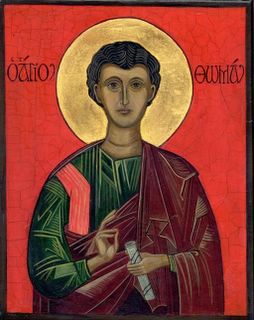
If you seek after prayer with concentration, then you will surely find prayer. Nothing is more essential to prayer than concentration. Do all that you can to acquire it. Evagrios of Pontus
I begin my day with prayer and meditation to minimize distractions.
I write my meditations to encourage concentration.
I publish these writings as a form of discipline.
But it is easy for such prayer to become narrowly self-referential.
In prayer the individual strings of relationship are presented for God's weaving.
Concentration is important. But so is the reach and depth of what we bring to God.
In prayer concentration is not achieved through exclusion, but through intensity of inclusion.
Wednesday, September 30, 2009

Thursday, September 17, 2009
Beginning on September 18 - Erev Rosh Hashanah - and continuing for ten days - until Yom Kippur - the Desert Fathers will be on hiatus as I observe and try to learn about the Jewish high holy days. Please join me at http://daysofawe-didymus.blogspot.com/

When you see Herod and Pilate making friends with each other in order to destroy Jesus, you may discern in this the concurrence of the demons of unchastity and self-esteem, who combine together to put to death the Logos of virtue and spiritual knowledge. For the demon of self-esteem, making a pretence of spiritual knowledge, refers to the demon of unchasitity, and the demon of unchastity, putting on a hypocritical show of purity refers back to the demon of self-esteem. Thus it is said, "When Herod had arrayed Jesus in a gorgeous robe, he sent him again to Pilate." (Maximos the Confessor)
Herod is the personification of sensuality and self-indulgence, Pilate of power projected and imposed.
It is said by some that Christianity is a blending of Jerusalem and Athens, while the Church is a combination of Babylon and Rome.
I struggle with self-esteem. I am not self-confident. I depend too much on the reassurance of others.
But might my self-doubt be a gift as much as stumbling block? While Babylon and Rome may occasionally titillate, mostly they repel me. Jerusalem and Athens are always calling.
The desert fathers reflect the austerity of their physical environment, they cultivated the disciplines of physical, intellectual, and spiritual aridity.
Today is the feast day of Hildegaard of Bingen, a spiritual mother of the lush Rhine valley. In her Song of Mary, Hildegaard teaches,
You glowing, most green, verdant sprout, In the movement of the spirit, in the midst of wise and holy seekers, you bud forth into light. Your time to blossom had come.
Balsam scented, in you the beautiful flower blossomed. It is the beautiful flower that lends its scent to those herbs, all that had shrivelled and wilted. It brings them lush greenness once more.
God created both arid and verdent. In each God may be found. We need not reject one or the other, if we engage both as expressions of God.
Wednesday, September 16, 2009
The manna which was given to Israel in the desert is the Logos of God. Those who eat it find that it supplies every spiritual delight. It is blended to suit every taste in accordance with the different desires of those who eat it, for it has the quality of every kind of spiritual food. Thus, to those who through the Spirit have been born from above by means of incoruptible seed, it comes as pure spiritual milk; to the weak it comes as vegetables sustaining the soul's passible aspect; to those in whom the soul's organs of perception have been trained by long practice to distinguish between good and evil it serves as solid food. (Maximos the Confessor)
We each and all receive the same spiritual sustenance. But we consume different portions, satisfy different hungers, and nourish different exertions of the soul.
If Maximos is right, we are each able to partake of the Logos of God in the manner best suited for us, in the present moment, for present purposes.
But there are also, it seems to me, spiritual bulemics and the spiritually obese. There are spiritual atheletes and spiritual couch potatoes. What we do with what we have been given varies dramatically.
Give us this day our daily bread. Give what is needed for this day. May I partake mindfully and joyfully. May I join with others in a thanksgiving feast.
May I truly taste what is offered. May I find the strength needed to fulfill the purposes for which it is given
We each and all receive the same spiritual sustenance. But we consume different portions, satisfy different hungers, and nourish different exertions of the soul.
If Maximos is right, we are each able to partake of the Logos of God in the manner best suited for us, in the present moment, for present purposes.
But there are also, it seems to me, spiritual bulemics and the spiritually obese. There are spiritual atheletes and spiritual couch potatoes. What we do with what we have been given varies dramatically.
Give us this day our daily bread. Give what is needed for this day. May I partake mindfully and joyfully. May I join with others in a thanksgiving feast.
May I truly taste what is offered. May I find the strength needed to fulfill the purposes for which it is given
Tuesday, September 15, 2009
All sacred Scripture can be divided in to flesh and spirit as if it were a spiritual man. For the literal sense of Scripture is flesh and its inner meaning is soul or spirit. Clearly someone wise abandons what is corruptible and unites his whole being to what is incorruptible. (Maximos the Confessor)
I like this distinction for Scripture as consisting of both the flesh and spirit. It strikes me as a real - and helpful - insight.
In a later saying, Maximos identifies the law with flesh and the prophets with spirit. Once again this strikes me as helpful.
But I am not yet persuaded of the need to abandon the flesh. My reading of the prophets - and especially of Jesus - is that they sought to infuse the flesh with the spiritual.
The material world is also the creation of God... and it is good. The prophets call us to recognize and retrieve the spiritual origins and purposes of the material.
We seek to unite inner meaning and outer appearance.
I like this distinction for Scripture as consisting of both the flesh and spirit. It strikes me as a real - and helpful - insight.
In a later saying, Maximos identifies the law with flesh and the prophets with spirit. Once again this strikes me as helpful.
But I am not yet persuaded of the need to abandon the flesh. My reading of the prophets - and especially of Jesus - is that they sought to infuse the flesh with the spiritual.
The material world is also the creation of God... and it is good. The prophets call us to recognize and retrieve the spiritual origins and purposes of the material.
We seek to unite inner meaning and outer appearance.
Monday, September 14, 2009

Many of us are talkers, few are doers. But no one should distort the word of God through his own negligence. He must confess his weakness and not hide God's truth. Otherwise he will be guility not only of breaking the commandments but also of falsifying the word of God. (Theodorus the Great)
We often fail to do what we claim to believe. Theodorus seems to say this is to be expected. But we must not seek to obscure this falure. We must admit to ourselves and others our inconsistency. Otherwise, we will mislead ourselves and others into mistaking what our belief means.
Sunday, September 13, 2009
Do not pray for your heart's desires, for they may not entirely harmonize with God's purposes. Pray instead as you have been taught: "May your will be done in me." Pray to God this way about everything, that his will might be accomplished in you, for he only desires what is good and useful in your life, whereas you do not always request this. (Evagrios of Pontus)
It is good to ask, thy will be done. But whatever we ask, we must also be attentive for God's reply. It is likely to come softly and may be a surprise. God's reply will also require our active assent. Perhaps we should pray thy will be done, and make me sensitive to thy will, and help me find the courage to do thy will. Amen.
It is good to ask, thy will be done. But whatever we ask, we must also be attentive for God's reply. It is likely to come softly and may be a surprise. God's reply will also require our active assent. Perhaps we should pray thy will be done, and make me sensitive to thy will, and help me find the courage to do thy will. Amen.
Saturday, September 12, 2009
When your spiritual intellect longs for God so deeply that little by little it loses interest in material things and turns away from all thoughts rooted in sensory perception, or those that rise from our temperament or our memories, and at the same time becomes more and more filled with a sense of reverence and joy, then know that you have drawn near to the threshold of prayer. (Evagrios of Pontus)
For several years - I am not sure when it began - I have read the daily meditation and psalm assigned by Forward Day by Day. On September 17 four years ago I began writing a daily meditation online.
I have not yet lost interest in material things. But little by little I have changed. My sense of relationship with God has grown. My sense of anxiety is less. I am not sure about reverence. But there is certainly joy.
Reading the daily meditation and writing another meditation is the first thing I do each morning. It is a wonderful way to begin. On most days with my first flicker of wakefulness I bound from bed, excited to see what will be found.
But according to Evagrios, I am barely on the threshold of prayer, perhaps still short of the threshold. If this is the experience in so short of time and with such modest effort, what wonders might come from fully entering a place of true prayer?
Dear God, thank you for bringing me to the pathway of prayer.
For several years - I am not sure when it began - I have read the daily meditation and psalm assigned by Forward Day by Day. On September 17 four years ago I began writing a daily meditation online.
I have not yet lost interest in material things. But little by little I have changed. My sense of relationship with God has grown. My sense of anxiety is less. I am not sure about reverence. But there is certainly joy.
Reading the daily meditation and writing another meditation is the first thing I do each morning. It is a wonderful way to begin. On most days with my first flicker of wakefulness I bound from bed, excited to see what will be found.
But according to Evagrios, I am barely on the threshold of prayer, perhaps still short of the threshold. If this is the experience in so short of time and with such modest effort, what wonders might come from fully entering a place of true prayer?
Dear God, thank you for bringing me to the pathway of prayer.
Friday, September 11, 2009

The heart itself is only a small vessel, yet dragons are there, and lions; there are poisonous beasts and all the treasures of evil; there are rough and uneven roads; there are precipices; but there, too, are God and the angels; life is there, and the Kingdom; there, too, is light, and there the apostles, and heavenly cities, and treasures of grace. All things lie within that little space. (Makarios the Great)
There is a paradox to creation that challenges human orthodoxy.
There is a mystery to creation that resists human wisdom.
There is an abundance to creation that confounds human pride.
Yet Jesus teaches us, "the kingdom of God is within you."
All that is and was and will be is within you and me.
Thursday, September 10, 2009
All immortal things and immortality itself, all living things and life itself, all holy things and holiness itself, all good things and goodness itself, all blessings and blessedness itself, all being and being itself are manifestly works of God. Some things began to be in time for they have not always existed. Others did not begin to be in time, for goodness, blessedness, holiness, and immortality have always existed. Those things which began in time exist and are said to exist by participation in the things which did not begin in time. For God is the creator of all life, immortality, holiness, and goodness; and He transcends the being of all intelligible and describable things. (Saint Maximos the Confessor, Philokalia)
This man, this son of a mother and father, this student, this husband and father, this singer, reader, and writer... this self began in time; I will also end in time.
But I may transcend time by participation in what did not begin in time. When I participate in goodness, blessedness, and holiness I partake of immortality.
I am a creature of time and of God. I have been made for both time - which begins and ends - and for God who has no beginning nor ending.
There is grace in each domain. Beginnings are good. Endings are good. May I be watchful and wise to know the right time for each.
That which transcends time is also good. It is truly blessed to lose all sense of time. May I be open to being swept beyond time.
This man, this son of a mother and father, this student, this husband and father, this singer, reader, and writer... this self began in time; I will also end in time.
But I may transcend time by participation in what did not begin in time. When I participate in goodness, blessedness, and holiness I partake of immortality.
I am a creature of time and of God. I have been made for both time - which begins and ends - and for God who has no beginning nor ending.
There is grace in each domain. Beginnings are good. Endings are good. May I be watchful and wise to know the right time for each.
That which transcends time is also good. It is truly blessed to lose all sense of time. May I be open to being swept beyond time.
Wednesday, September 9, 2009
There is never an end, as there is never a beginning, to the good which God does: just as the property of light is to illuminate, so the property of God is to do good. Thus in the Law, which is concerned with the structure of temporal things subject to generation and decay, the sabbath is honoured by rest from work, whereas in the Gospel, which initiates us into the realm of spiritual realities, lustre is shed on the sabbath by good actions. (Saint Maximos the Confessor, Philokalia)
I do not perceive that Jesus distinguished quite so clearly between the temporal and spiritual realms. He did not come to abolish the law, but to fulfill it.
But in such fulfilling the law, as we may have understood it, can be transformed. For the spiritual law is not concerned with generation and decay, but with abundance.
God is the ultimate reality. In God there is never an end, as there is never a beginning. In this ultimate reality there is the continual action of creative, self-giving love.
I do not perceive that Jesus distinguished quite so clearly between the temporal and spiritual realms. He did not come to abolish the law, but to fulfill it.
But in such fulfilling the law, as we may have understood it, can be transformed. For the spiritual law is not concerned with generation and decay, but with abundance.
God is the ultimate reality. In God there is never an end, as there is never a beginning. In this ultimate reality there is the continual action of creative, self-giving love.
Tuesday, September 8, 2009

He who imitates the disciples of the Lord does not refuse, out of fear for the Pharisees, to walk through the cornfields on the sabbath and pluck ears of corn. On the contrary, when after practicing the virtues he attains the state of dispassion, he culls the inner principles of created beings and devoutly nourishes himself with the divine knowledge they contain. (Saint Maximos the Confessor)
In making our sabbath journey, we are to partake of the abundance that God has given. In the traditions of many cultures, in the lives of every person, in the unfolding joys and sorrows of this day there is much to learn.
When I was young, around this time of year we would harvest sweet corn. The whole family - aunts, uncles, cousins, and grandparents, great aunts, and second, third, and fourth cousins - would gather around the corn truck.
Each ear was stripped of its tight green cover, and combed of its blond strands, and washed in a tub of cold water. Some could not wait and ate it raw. But for those who would wait, the boiled corn was even sweeter.
Sunday, September 6, 2009
A soul can never attain the knowledge of God unless God Himself in His condescension takes hold of it and raises it up to Himself. For the human intellect lacks the power to ascend and to participate in divine illumination, unless God Himself draws it up - in so far as this is possible for the human intellect - and illumines it with rays of divine light. (Saint Maximos the Confessor)
Is God condescending? We use the term for patronizing behavior, designed to sharpen the sense of separation between higher and lower.
The original Latin means to "let oneself down" or literally "together descend." I am not sure of Saint Maximos' meaning, but I hear something nearly opposite to our typical meaning.
God reaches out to be together with us. Given the nature of God, we can perceive this as a reaching down. At some point we deigned ourselves too big to take the hand of our mother or father crossing the road.
Did there also come a time when we reached out to hold the hand of another? Was there another time in love, or grief, or joy, or in simple thanksgiving for being together that we received the hand of another?
We can refuse to receive what God offers, but the opportunity continues to be offered.
Is God condescending? We use the term for patronizing behavior, designed to sharpen the sense of separation between higher and lower.
The original Latin means to "let oneself down" or literally "together descend." I am not sure of Saint Maximos' meaning, but I hear something nearly opposite to our typical meaning.
God reaches out to be together with us. Given the nature of God, we can perceive this as a reaching down. At some point we deigned ourselves too big to take the hand of our mother or father crossing the road.
Did there also come a time when we reached out to hold the hand of another? Was there another time in love, or grief, or joy, or in simple thanksgiving for being together that we received the hand of another?
We can refuse to receive what God offers, but the opportunity continues to be offered.
The sabbath rest of God signifies the complete reversion of created beings to God. It is then that God suspends in created beings the operation of their natural energy by inexpressibly activating in them His divine energy. It is by virtue of this natural energy that each created being naturally acts; and God suspends its operation in each created being to the degree to which that being participates in His divine energy and so establishes its own natural energy within God Himself. (Saint Maximos the Confessor)
The energy I bring to any task may be inspired by God or motivated by my desire for God; but while I seek to remain in control it will be entirely different from the energy of God.
There is immense value in a disciplined detachment from self and, as much as possible, a complete opening to God.
Even if this giving away of control might only happen every seventh day - or seventieth day - our natural energy can incrementally be joined with that of God.
The energy I bring to any task may be inspired by God or motivated by my desire for God; but while I seek to remain in control it will be entirely different from the energy of God.
There is immense value in a disciplined detachment from self and, as much as possible, a complete opening to God.
Even if this giving away of control might only happen every seventh day - or seventieth day - our natural energy can incrementally be joined with that of God.
Saturday, September 5, 2009

If a man impetuously interrupts a speech at a public meeting he clearly reveals his lust for self-glory. Over-powered by this passion, he tries to obstruct the course of the discussion with over-complicated proposals. (St. Maximos the Confessor, Philokalia)
I seldom allow the news of the day to invade my morning meditations. But this seemed to jump off the page.
It is the twenty-seventh of two-hundred "texts" on Theology and the Incarnate Dispensation of the Son of God by a First Century saint.
The texts begin with, "God is one, unoriginate, incomprehensible, possessing completely the total potentiality of being, altogether excluding notions of when and how, inaccessible to all, and not to be known through natural image by any creature."
Twenty-six texts later the logic of divine nature unfolds into how we ought to behave at a public meeting.
Our relationship with God depends a great deal on how we are in relationship with every aspect of God's creation.
Friday, September 4, 2009
Whether you pray alone or in the company of others, try never to pray simply as a matter of routine but always with conscious awareness of what you are doing. (Evagrios of Pontus)
This is wise counsel for all that we do.
In plowing, planning, and painting, as well as in prayer be mindful of what you are doing.
In cooking, carpentry, and even in camping, be mindful of what you are doing.
In choosing when you speak, and what you say, and how you say it, be mindful of what you are doing.
Each action can be approached prayerfully and achieved sacramentally through our openness to God's grace.
This is wise counsel for all that we do.
In plowing, planning, and painting, as well as in prayer be mindful of what you are doing.
In cooking, carpentry, and even in camping, be mindful of what you are doing.
In choosing when you speak, and what you say, and how you say it, be mindful of what you are doing.
Each action can be approached prayerfully and achieved sacramentally through our openness to God's grace.
Thursday, September 3, 2009
If we want to set our lives right and find peace, it is not the tolerant attitude of others that will do it for us. It will come about, rather, by our learning how to show compassion to them. If we try to avoid this hard struggle of compassion by preferring a withdrawn and solitary life, we will simply drag our unhealed obsessions into solitude with us. We might well have hidden them. We certainly will not have eliminated them. If we do not seek liberation from our obsessions, then becoming more withdrawn and less social may even make us more blind to them, since it can mask them. (John Cassian)
Cassian sounds like a precursor of Sigmund Freud. We do not progress by suppressing.
Retreat, even into the arms of God, is no relief if we bring the cause of suffering with us.
Unlike Freud, however, I will not be healed by focusing more and more on myself. Rather it is through cultivation of compassionate relationships with others that I will purge myself of obsessions.
Cassian sounds like a precursor of Sigmund Freud. We do not progress by suppressing.
Retreat, even into the arms of God, is no relief if we bring the cause of suffering with us.
Unlike Freud, however, I will not be healed by focusing more and more on myself. Rather it is through cultivation of compassionate relationships with others that I will purge myself of obsessions.
Wednesday, September 2, 2009

Keep a careful watch on yourself. Do not allow yourself to be swept away by external obsessions. The tumultuous movements of the soul, in particular, can be rendered quiet by stillness. But if you keep encouraging and stimulating them, they will start to terrorize you and can disorder your whole life. Once they are in control, it is as hard to heal them as it is to soothe a sore that we can't stop scratching. (Abba Philemon)
I do not hear in this a rejection of the external world. But there is a need to discipline how we perceive and engage the world.
Looking at pictures of anothers wedding we may need to consciously focus on the wedding couple, rather than the pride or worry with which we spy ourselves in the background. Without discipline, our perception tends to amplify our place in the world.
You, me, we -- are important. But we are only a tiny aspect of the wider reality of God. We are invited to join God in this wider view.
Tuesday, September 1, 2009
One of the monks asked the great teacher Abba Nistero: "What should I do for the best in life?" And the abba answered: "All works are not equal. The scripture says that Abraham was hospitable, and God was with him; it says that Elias loved quiet, and God was with him; it says that David was humble, and God was with him. So, whatever path you find your soul longs after in the quest for God, do that, and always watch over your heart's integrity." (Sayings of the Elders)
Each way to God may be narrow, but there are many ways.
We are free to choose the way we prefer.
But once on the way we should not forget its purpose. It is the way to God.
Each way to God may be narrow, but there are many ways.
We are free to choose the way we prefer.
But once on the way we should not forget its purpose. It is the way to God.
Subscribe to:
Comments (Atom)